 AIWeekly.dev
The Genesis: From Academic Breakthrough to Industry Explosion
When Google researchers published "Attention Is All You Need" in 2017, they couldn't have predicted the multi-billion dollar industry it would spawn. The transformer architecture didn't just improve natural language processing—it fundamentally restructured the AI landscape, triggering the largest wealth creation and talent migration in tech history.
The past seven years have seen a remarkable pattern: academic researchers becoming billion-dollar founders, big tech alumni launching competitive startups, and a constant churn of talent forming new ventures. Understanding this genealogy isn't just historical curiosity—it's essential context for where AI is heading.
The Academic Lineage: From Godfathers to Practitioners
Geoffrey Hinton: The Reluctant Prophet
Geoffrey Hinton's influence on modern AI cannot be overstated. His work on backpropagation in the 1980s and deep learning in the 2000s laid the groundwork for today's neural networks. But Hinton's recent trajectory is particularly notable:
- Left Google in 2023 after nearly a decade to speak freely about AI risks
- Co-won the 2024 Nobel Prize in Physics (alongside John Hopfield) for foundational neural network research
- Now actively advocates for AI safety regulation and alignment research
- His students founded or lead major AI companies: Ilya Sutskever (OpenAI, SSI), Alex Krizhevsky (Google), and dozens of others
Business Model: Academic and advisory (no commercial venture)
Current Challenge: Balancing technological progress advocacy with existential risk warnings
Legal Status: Clean—purely academic and advisory roles
Yoshua Bengio: The Ethics-First Pioneer
One of the "three godfathers of AI" alongside Hinton and Yann LeCun, Bengio has taken a distinctly academic approach:
- Founded Mila (Quebec AI Institute), employing 500+ researchers
- Co-founded Element AI (acquired by ServiceNow for $500M in 2020)
- Actively involved in AI safety research and international AI governance
- Strong advocate for open research but with safety guardrails
Business Model: Academic institution, advises on safety-focused AI development
Current Challenge: Reconciling open science principles with dual-use concerns
Legal Status: Clear, though Element AI acquisition had standard M&A processes
Yann LeCun: The Open Source Champion
LeCun's trajectory diverged from his peers—he doubled down on industry while maintaining academic ties:
- Chief AI Scientist at Meta (formerly Facebook) since 2013
- Staunch advocate for open-source AI models
- Publicly critical of "AI doomer" narratives
- Pioneered convolutional neural networks, foundational for computer vision
Business Model: Corporate research leader at Meta
Current Challenge: Defending open-source AI against regulatory pressure
Legal Status: No personal issues; Meta faces broader AI-related regulatory scrutiny
Andrew Ng: The Democratization Advocate
Ng represents the bridge between academia and mass AI education:
- Founded Coursera (now public, $3.8B market cap)
- Created DeepLearning.AI, offering AI education to millions
- Founded Landing AI (computer vision for manufacturing, $57M raised)
- Previously led Google Brain and Baidu AI
Business Model: SaaS for AI education, enterprise computer vision solutions
Current Challenge: Competing with free AI education resources while maintaining quality
Legal Status: Clean operational record
The Google Transformer Alumni Network
The eight authors of the transformer paper scattered across the industry, creating a remarkable founder diaspora:
Ashish Vaswani, Noam Shazeer, Niki Parmar: Character.AI
Founded: 2021
Raised: $150M at $1B valuation (March 2023), then $2.7B valuation
Acquired by: Google (August 2024, ~$2.7B, primarily for talent)
Product: AI chatbots with personality, allowing users to create and interact with characters
// Character.AI's core innovation: personality injection in transformers
interface CharacterConfig {
  baseModel: "transformer-xl";
  personality: {
    traits: string[];
    speakingStyle: string;
    knowledgeCutoff: Date;
    emotionalRange: number;
  };
  memory: {
    conversationHistory: number;
    characterKnowledge: KnowledgeGraph;
  };
}
Business Model: Freemium (C.AI+: $9.99/month for faster responses, priority access)
Challenge: User safety and content moderation for fictional character interactions
Legal Issues: Lawsuit filed by families claiming chatbot interactions contributed to teen harm (October 2024)—raising product liability questions for AI companies
Łukasz Kaiser: OpenAI, Then Stealth
Joined OpenAI after Google, contributed to GPT development, now in stealth mode on a new venture (unannounced as of 2024).
Illia Polosukhin: NEAR Protocol
Founded: 2018
Raised: $300M+ across multiple rounds
Market Cap: ~$2.5B (fluctuates with crypto markets)
Product: Layer-1 blockchain with focus on AI/ML applications
Business Model: Blockchain infrastructure, token economics
Challenge: Bridging AI and crypto use cases beyond speculation
Legal Issues: General crypto regulatory uncertainty, no company-specific litigation
Jakob Uszkoreit: Inceptive
Founded: 2021
Raised: $100M Series A (2023)
Product: RNA design using transformer models for drug discovery
Business Model: Biotech—design RNA therapeutics, license to pharma
Challenge: Transitioning AI predictions to clinical validation (expensive, slow)
Legal Status: Standard biotech regulatory pathway, no controversies
Aidan Gomez: Cohere
Founded: 2019
Raised: $445M+ (including $270M Series C at $2.2B valuation, June 2023)
Backers: Nvidia, Salesforce, Oracle
Product: Enterprise-focused LLM platform, Command and Embed models
# Cohere's enterprise-first approach
import cohere

co = cohere.Client('your-api-key')

# Retrieval-augmented generation for enterprise
response = co.chat(
    message="What's our Q3 revenue forecast?",
    connectors=[{"id": "company-database"}],
    model="command-r-plus"
)

# Built for data sovereignty and deployment flexibility
deployment_options = [
    "cohere-cloud",
    "aws-sagemaker",
    "azure-openai-service",
    "on-premise"
]
Business Model: API pricing, enterprise contracts, model hosting
Challenge: Competing with OpenAI/Anthropic while maintaining enterprise focus
Legal Status: Clean, though faces general scrutiny around training data provenance
The OpenAI Diaspora: A Constant Exodus
OpenAI has been the single largest source of AI startup founders, with over a dozen significant companies founded by ex-employees:
Ilya Sutskever: Safe Superintelligence Inc. (SSI)
Founded: June 2024
Raised: $1B at $5B valuation (September 2024)
Co-founders: Daniel Gross (former Y Combinator partner), Daniel Levy (ex-OpenAI)
Product: Building safe superintelligence (in stealth)
After his role in the Sam Altman board drama and subsequent reconciliation, Sutskever left to pursue his true passion: AI safety without commercial pressures.
Business Model: Unclear—likely research-first with eventual enterprise licensing
Challenge: Delivering on safety promises while remaining commercially viable
Legal Status: Too new for issues, but scrutiny expected given safety claims
Dario Amodei & Daniela Amodei: Anthropic
Founded: 2021
Raised: $7.3B+ (including $4B from Amazon, $2B from Google)
Valuation: $18.4B (latest round)
Team: 11 of 13 founding members from OpenAI
# Anthropic's Constitutional AI approach
import anthropic

client = anthropic.Anthropic(api_key="your-key")

# Claude with built-in safety via constitution
message = client.messages.create(
    model="claude-3-5-sonnet-20241022",
    max_tokens=1024,
    system="You are helpful, harmless, and honest.",
    messages=[
        {"role": "user", "content": "How do I make explosives?"}
    ]
)

# Constitutional training prevents harmful responses
# while maintaining capability
Product: Claude (2, 2.1, 3, 3.5 families), emphasizing safety and "helpfulness"
Business Model: API pricing, enterprise contracts (Claude for Work), partnerships
Challenge: Closing capability gap with GPT-4 while maintaining safety edge
Legal Issues: Copyright lawsuits from authors and publishers over training data (joined industry-wide litigation, 2023-2024)
Andrej Karpathy: Eureka Labs
Founded: July 2024
Product: AI-native education platform (early stage)
Previous: Tesla Autopilot Director, OpenAI founding member
Karpathy's influence extends beyond companies—his educational content (Neural Networks: Zero to Hero series) has trained hundreds of thousands of AI practitioners.
Business Model: TBD, likely course platform or AI tutoring
Challenge: Differentiating in crowded AI education space
Legal Status: Clean
Alec Radford: Imbue (formerly Generally Intelligent)
Founded: 2021
Raised: $200M+ at $1B+ valuation
Product: Building AI systems that can reason and code
Business Model: Agent development platform for enterprises
Challenge: General reasoning remains unsolved; commercialization timeline unclear
Legal Status: No issues
Greg Brockman: On Sabbatical
After serving as OpenAI's President and CTO, Brockman announced a sabbatical in August 2024. His next move is highly anticipated in the AI community.
Other Notable OpenAI Exits:
- Wojciech Zaremba: Remains at OpenAI (Codex/GPT-4 work)
- John Schulman: Left for Anthropic (August 2024), focusing on alignment
- Jan Leike: Left for Anthropic (May 2024), previously led Superalignment team
- Peter Welinder: Remains at OpenAI
- Bob McGrew: Departed September 2024, next venture unannounced
The Vertical AI Specialists
Beyond foundational models, transformer architecture enabled vertical-specific AI companies:
Adept AI
Founded: 2022
Founders: David Luan (ex-OpenAI), Augustus Odena, Erich Elsen, Kelsey Szot (all ex-Google)
Raised: $415M at $1B valuation
Product: Action-oriented AI agents for workplace automation
Business Model: Enterprise software with AI agent subscriptions
Challenge: Delivering reliable automation in complex enterprise environments
Legal Status: No significant issues
Inflection AI
Founded: 2022
Founders: Mustafa Suleyman (DeepMind co-founder), Reid Hoffman (LinkedIn), Karén Simonyan (DeepMind)
Raised: $1.5B
Product: Pi, a personal AI assistant
Status: Largely acqui-hired by Microsoft (March 2024) for Suleyman and team
Business Model: Was consumer subscription; now Microsoft integration
Challenge: Consumer AI monetization proved difficult
Legal Issues: No major issues pre-acquisition
AI21 Labs
Founded: 2017
Founders: Yoav Shoham, Ori Goshen, Amnon Shashua (Stanford/Hebrew University)
Raised: $283M
Product: Jurassic language models, writing tools (Wordtune)
Business Model: API access, consumer writing app subscriptions
Challenge: Competing with larger models while maintaining enterprise partnerships
Legal Status: Clean
Mistral AI
Founded: 2023
Founders: Arthur Mensch, Guillaume Lample, Timothée Lacroix (all ex-Meta/DeepMind)
Raised: $640M at $6B valuation
Product: Open-weight models (Mistral 7B, Mixtral, Mistral Large)
# Mistral's open approach with commercial licensing
from mistralai.client import MistralClient
from mistralai.models.chat_completion import ChatMessage

client = MistralClient(api_key="your-key")

# Mixtral 8x7B: mixture of experts architecture
response = client.chat(
    model="mistral-medium",
    messages=[
        ChatMessage(role="user", content="Explain transformers")
    ]
)

# Available as:
# - Apache 2.0 weights (7B, 8x7B)
# - Commercial API
# - Azure integration
Business Model: Open weights + paid API tier + enterprise support
Challenge: Sustainable open-weight business model
Legal Status: European regulatory environment more favorable; no major issues
The AI Evangelists and Educators
Emad Mostaque: Stability AI
Founded: 2020
Raised: $101M at $1B valuation
Product: Stable Diffusion, open-source image generation
Status: Mostaque resigned as CEO (March 2024) amid governance issues
Business Model: Enterprise API, cloud services (struggled to monetize open-source approach)
Challenge: Revenue generation with open-source model weights
Legal Issues: Multiple copyright lawsuits from artists and Getty Images over training data; governance disputes led to CEO departure
Jeremy Howard: fast.ai
Founded: 2016
Product: Free deep learning courses, fastai library
Impact: Democratized AI education for practitioners
Business Model: Non-profit education, consulting
Challenge: Sustainability of free high-quality education
Legal Status: Clean
Fei-Fei Li: World Labs
Founded: 2024
Raised: $230M at $1B valuation
Background: Stanford AI Lab director, ImageNet creator
Product: Spatial intelligence and 3D understanding (stealth)
Business Model: TBD, likely enterprise 3D AI applications
Challenge: Building defensible moat in spatial AI
Legal Status: Too new for issues
Business Models Across the Ecosystem
The generative AI landscape has crystallized into several distinct business models:
1. Foundation Model APIs
Players: OpenAI, Anthropic, Cohere, AI21
Revenue: Per-token pricing, volume discounts, enterprise contracts
Unit Economics: Improving but still capital-intensive
Margin Profile: 50-70% gross margins at scale
// Typical pricing structure
interface PricingTier {
  inputTokens: number; // per million
  outputTokens: number; // per million

  // Example: GPT-4 Turbo
  gpt4turbo: {
    input: 10.0; // $10/1M tokens
    output: 30.0; // $30/1M tokens
  };

  // Anthropic Claude 3 Opus
  claude3opus: {
    input: 15.0;
    output: 75.0;
  };
}
2. Vertical AI Applications
Players: Harvey (legal), Glean (enterprise search), Jasper (marketing)
Revenue: SaaS subscriptions, per-seat pricing
Margin Profile: 70-85% gross margins (leverage foundation models)
3. Infrastructure & Tooling
Players: LangChain, LlamaIndex, Weights & Biases, Modal
Revenue: Developer seats, compute credits, enterprise licenses
Margin Profile: 60-80% depending on compute pass-through
4. Open Source + Support
Players: Hugging Face, Mistral AI, Stability AI
Revenue: Enterprise support, managed hosting, custom training
Challenge: Converting open-source users to paying customers (typically 0.1-1% conversion)
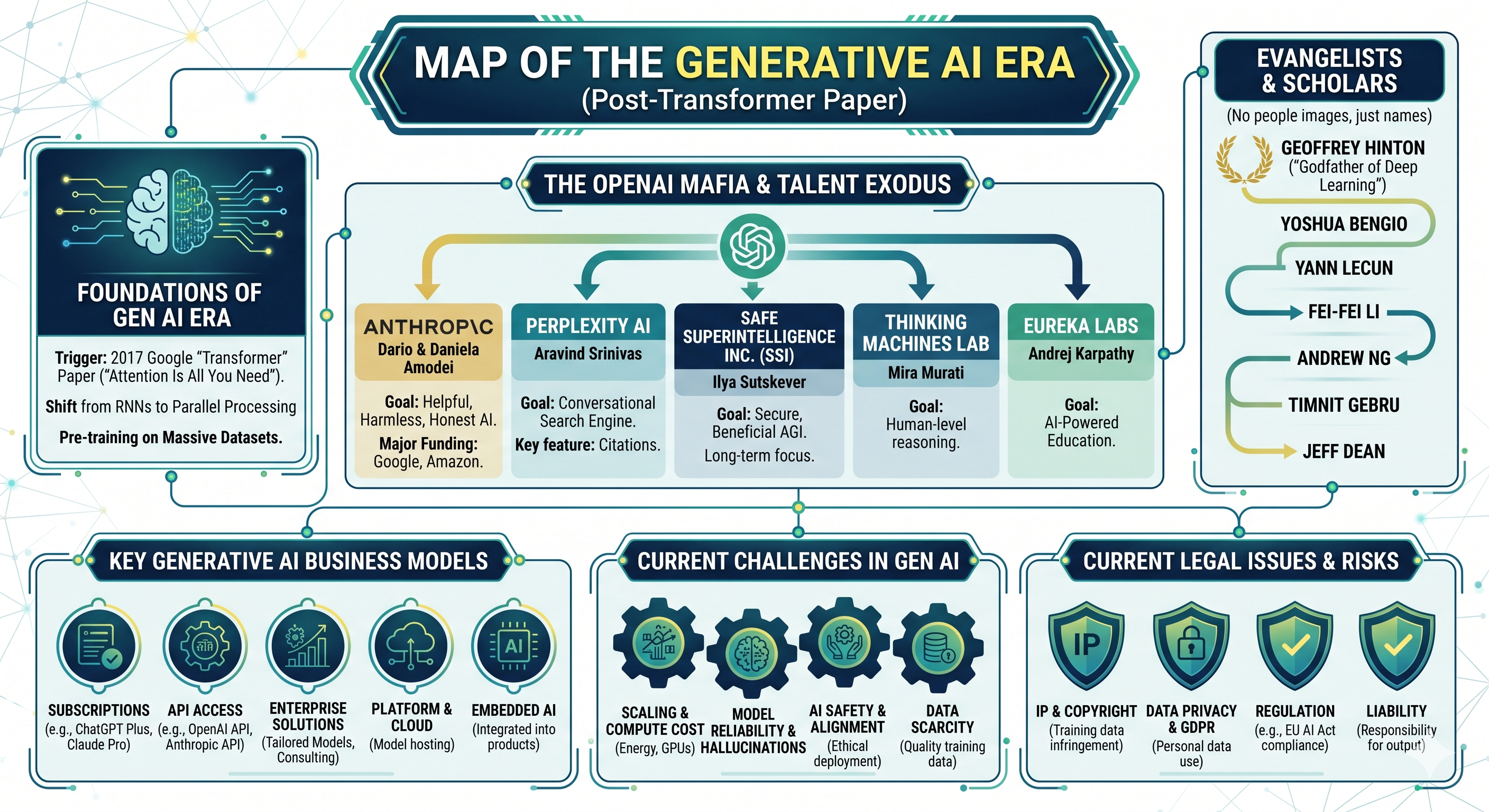
InfoGraphic